
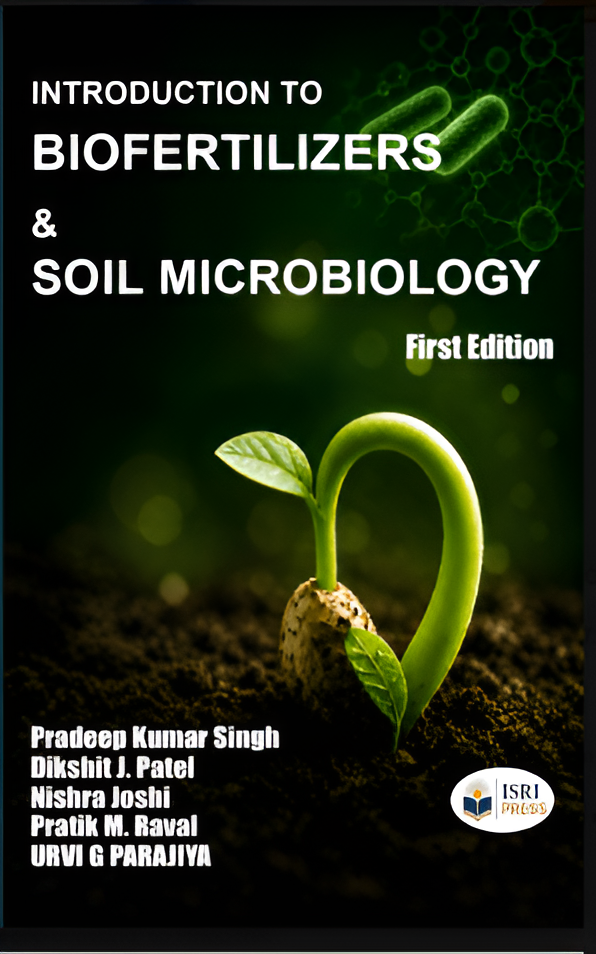
Introduction to Biofertilizers and Soil Microbiology
About the Book
Introduction to Biofertilizers and Soil Microbiology: Integrating Microbial Science with Sustainable Agricultural Practice is a comprehensive and systematically structured textbook that integrates soil microbiology, microbial ecology, nutrient biogeochemistry, biofertilizer technology, and sustainable agriculture into a unified academic framework. The book is designed to provide students, researchers, agricultural professionals, microbiologists, soil scientists, and practitioners with both the scientific foundations and practical understanding required to evaluate and apply microbial technologies in sustainable agricultural systems.
The book begins with the fundamentals of soil microbiology, examining soil as a complex living ecosystem and exploring soil formation, composition, microbial diversity, ecosystem dynamics, soil organic matter, humus, and the environmental factors that influence microbial activity. It establishes the importance of microorganisms in maintaining soil fertility and supporting agricultural productivity.
The book then explores soil microbial ecology and rhizosphere biology, with detailed discussions of the rhizosphere, plant–microbe interactions, microbial communication, microbial communities, competition and cooperation, plant growth-promoting rhizobacteria (PGPR), and rhizosphere engineering. These concepts provide an essential foundation for understanding how microorganisms interact with plants and contribute to crop growth and soil health.
A major section of the book focuses on nutrient cycling and soil biogeochemistry, covering the carbon, nitrogen, phosphorus, sulfur, and potassium cycles, micronutrient transformations, soil enzyme activities, and the microbial processes that regulate nutrient availability. The text connects these biogeochemical processes with soil fertility and sustainable nutrient management.
The central chapters provide an in-depth examination of biofertilizers and their agricultural applications. Major categories include nitrogen-fixing microorganisms such as Rhizobium, Azotobacter, Azospirillum, cyanobacteria, Azolla, and Frankia, together with phosphate-solubilizing microorganisms, potassium-mobilizing microorganisms, zinc and micronutrient solubilizers, and mycorrhizal fungi. Their mechanisms of action, agricultural applications, and contributions to plant nutrient acquisition are examined systematically.
The book also provides practical coverage of biofertilizer production technology and quality control, including industrial production, fermentation technology, carrier materials, liquid formulations, shelf life, storage, quality standards, regulations, packaging, commercialization, and biofertilizer entrepreneurship. These chapters help bridge the gap between microbial science and the practical development and use of biofertilizer products.
The later chapters address soil health, climate change, and sustainable agriculture, including soil health indicators, soil degradation and restoration, climate impacts on soil microbial processes, carbon sequestration, organic farming, integrated nutrient management, and the role of agriculture in achieving the Sustainable Development Goals.
The final section provides a forward-looking perspective on emerging technologies in biofertilizer research, including metagenomics and soil microbiome analysis, nanobiofertilizers, artificial intelligence in soil analysis, precision agriculture, synthetic microbial consortia, and CRISPR-based genetic engineering. These emerging approaches highlight the evolving role of microbial biotechnology in developing intelligent, efficient, and environmentally sustainable agricultural systems.
Supported by tables, figures, chapter summaries, and systematically organized topics, the book is structured as both a comprehensive academic textbook and a useful reference resource. It provides a progressive understanding of soil microbial science while emphasizing the practical importance of microorganisms in improving soil fertility, nutrient-use efficiency, crop productivity, and long-term agricultural sustainability.
Key Features
- Comprehensive integration of Soil Microbiology, Biofertilizers, Microbial Ecology, and Sustainable Agriculture
- Fundamentals of soil formation, composition, microbial diversity, and soil ecosystem dynamics
- Detailed coverage of rhizosphere biology and plant–microbe interactions
- Plant Growth-Promoting Rhizobacteria (PGPR) and rhizosphere engineering
- Comprehensive treatment of carbon, nitrogen, phosphorus, sulfur, and potassium cycling
- Microbial nutrient transformations and soil enzyme activities
- Principles, classification, mechanisms, and applications of biofertilizers
- Biological nitrogen fixation and Rhizobium, Azotobacter, Azospirillum, cyanobacteria, Azolla, and Frankia
- Phosphate-solubilizing and potassium-mobilizing microorganisms
- Zinc and micronutrient-solubilizing microorganisms
- Mycorrhizae and fungal biofertilizers, including AMF and ectomycorrhizae
- Biofertilizer production, fermentation technology, carrier materials, and formulations
- Shelf life, storage, quality standards, regulations, packaging, and commercialization
- Biofertilizer entrepreneurship and agricultural applications
- Soil health, soil degradation, restoration, and sustainable soil management
- Climate change, carbon sequestration, organic farming, and integrated nutrient management
- Sustainable Development Goals and the role of agriculture
- Emerging technologies including metagenomics, nanobiofertilizers, AI, precision agriculture, and synthetic microbial consortia
- Introduction to CRISPR and genetic engineering in biofertilizer research
- Numerous academic tables, figures, and chapter summaries
- Suitable as a university textbook, teaching resource, and research reference
Target Audience
This book is intended for undergraduate and postgraduate students of agriculture, soil science, microbiology, and biotechnology, as well as researchers, agricultural extension officers, biofertilizer manufacturers, quality control professionals, and policymakers. It is particularly useful for those interested in applying microbial technologies to improve soil fertility and sustainable crop production.
Keywords
Keywords: Biofertilizers, Soil Microbiology, Nitrogen Fixation, Rhizobium, Azotobacter, Mycorrhizae, Phosphate Solubilizing Bacteria, Nutrient Cycling, Sustainable Agriculture, Rhizosphere Biology, Metagenomics, Nanobiofertilizers, Soil Health, PGPR, Nitrogenase, Carbon Sequestration, Integrated Nutrient Management.
Contents
| Chapter | Title | Page |
|---|---|---|
| Copyright | 1 | |
| Publisher’s Note | 2 | |
| Abstract | 3 | |
| Preface | 5 | |
| Acknowledgement | 7 | |
| Meet the Authors | 8 | |
| List of Tables | 14 | |
| List of Figures | 16 | |
| List of Abbreviations | 17 | |
| Chapter 1 : Fundamentals of Soil Microbiology | 19 | |
| 1.1 | Introduction to Soil Microbiology | 20 |
| 1.2 | Soil Formation and Composition | 23 |
| 1.3 | Soil Microbial Diversity | 27 |
| 1.4 | Soil Ecosystem Dynamics | 31 |
| 1.5 | Soil Organic Matter and Humus | 34 |
| 1.6 | Environmental Factors Affecting Soil Microbes | 36 |
| 1.7 | Importance of Soil Microbiology in Agriculture | 41 |
| Chapter 2 : Soil Microbial Ecology and Rhizosphere Biology | 45 | |
| 2.1 | Rhizosphere Concept | 46 |
| 2.2 | Plant-Microbe Interactions | 50 |
| 2.3 | Microbial Communication | 52 |
| 2.4 | Soil Microbial Communities | 55 |
| 2.5 | Microbial Competition and Cooperation | 57 |
| 2.6 | Rhizobacteria and PGPR | 59 |
| 2.7 | Rhizosphere Engineering | 61 |
| Chapter 3 : Nutrient Cycling and Soil Biogeochemistry | 65 | |
| 3.1 | Carbon Cycle in Soil | 66 |
| 3.2 | Nitrogen Transformation Processes | 68 |
| 3.3 | Phosphorus Dynamics | 75 |
| 3.4 | Sulfur and Potassium Cycling | 79 |
| 3.5 | Micronutrient Transformation | 80 |
| 3.6 | Enzymatic Activities in Soil | 81 |
| 3.7 | Biogeochemical Interactions and Soil Fertility | 82 |
| Chapter 4 : Biofertilizers — Principles and Classification | 87 | |
| 4.1 | Introduction to Biofertilizers | 88 |
| 4.2 | Types of Biofertilizers | 90 |
| 4.3 | Mechanisms of Action | 94 |
| 4.4 | Carrier-Based and Liquid Biofertilizers | 96 |
| 4.5 | Biofertilizer Formulations | 99 |
| 4.6 | Benefits and Limitations | 102 |
| 4.7 | Role in Sustainable Agriculture | 104 |
| Chapter 5 : Nitrogen-Fixing Microorganisms | 108 | |
| 5.1 | Biological Nitrogen Fixation | 109 |
| 5.2 | Rhizobium Technology | 111 |
| 5.3 | Azotobacter and Azospirillum | 114 |
| 5.4 | Cyanobacteria and Azolla | 117 |
| 5.5 | Frankia and Actinorhizal Symbiosis | 119 |
| 5.6 | Nitrogenase Enzyme System | 121 |
| 5.7 | Agricultural Applications | 123 |
| Chapter 6 : Phosphate Solubilizing and Potassium Mobilizing Microbes | 126 | |
| 6.1 | Phosphorus Deficiency in Soil | 127 |
| 6.2 | Phosphate Solubilizing Bacteria | 129 |
| 6.3 | Phosphate Solubilizing Fungi | 131 |
| 6.4 | Organic Acid Production | 133 |
| 6.5 | Potassium Solubilizing Microorganisms | 134 |
| 6.6 | Zinc and Micronutrient Solubilizers | 138 |
| 6.7 | Crop Productivity Enhancement | 139 |
| Chapter 7 : Mycorrhizae and Fungal Biofertilizers | 144 | |
| 7.1 | Introduction to Mycorrhizae | 145 |
| 7.2 | Arbuscular Mycorrhizal Fungi | 146 |
| 7.3 | Ectomycorrhizae | 149 |
| 7.4 | Plant Nutrient Uptake Enhancement | 151 |
| 7.5 | Stress Tolerance Mechanisms | 154 |
| 7.6 | Mycorrhizae in Sustainable Agriculture | 155 |
| 7.7 | Commercial Applications | 157 |
| Chapter 8 : Production Technology and Quality Control of Biofertilizers | 160 | |
| 8.1 | Industrial Production of Biofertilizers | 161 |
| 8.2 | Fermentation Technology | 163 |
| 8.3 | Carrier Materials | 166 |
| 8.4 | Shelf Life and Storage | 167 |
| 8.5 | Quality Standards and Regulations | 169 |
| 8.6 | Packaging and Commercialization | 170 |
| 8.7 | Biofertilizer Entrepreneurship | 172 |
| Chapter 9 : Soil Health, Climate Change, and Sustainable Agriculture | 175 | |
| 9.1 | Soil Health Indicators | 176 |
| 9.2 | Soil Degradation and Restoration | 178 |
| 9.3 | Climate Change and Soil Microbiology | 180 |
| 9.4 | Carbon Sequestration | 181 |
| 9.5 | Organic Farming Systems | 184 |
| 9.6 | Integrated Nutrient Management | 185 |
| 9.7 | Sustainable Development Goals and Agriculture | 186 |
| Chapter 10 : Emerging Technologies and Future Perspectives | 189 | |
| 10.1 | Metagenomics and Soil Microbiome | 190 |
| 10.2 | Nanobiofertilizers | 192 |
| 10.3 | Artificial Intelligence in Soil Analysis | 194 |
| 10.4 | Precision Agriculture | 196 |
| 10.5 | Synthetic Microbial Consortia | 197 |
| 10.6 | CRISPR and Genetic Engineering | 199 |
| 10.7 | Future Trends in Biofertilizer Research | 201 |
| References | 205 | |





Recommended Citation
APA 7th Edition